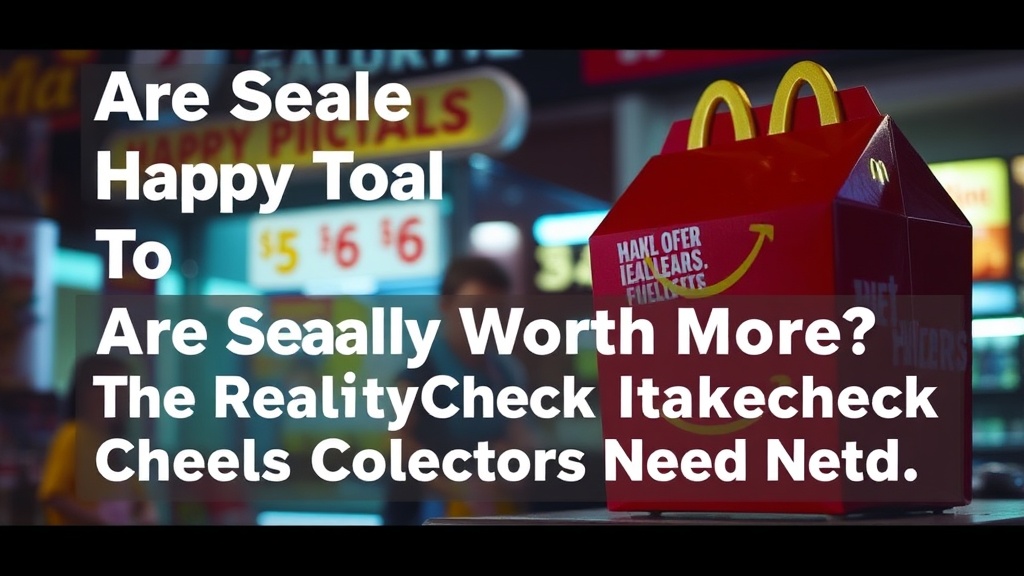
Are Sealed Happy Meal Toys Actually Worth More? The Reality Check Collectors Need

Walk into any collector's meetup and you'll hear it—"keep it sealed, keep it valuable." It's the golden rule that's been passed around Facebook groups and Reddit threads for years. Here's the uncomfortable truth that nobody wants to say out loud: sealed packaging isn't always the preservation panacea we've been sold. Sometimes, that factory-sealed bag or box is doing more harm than good—and understanding when to break the seal could save your collection from irreversible damage.
This guide cuts through the mythology surrounding sealed Happy Meal toys. We'll examine what "sealed" actually means in the McDonald's collectible world, why some sealed items deteriorate faster than their opened counterparts, and how to make smart decisions about when to display, when to store, and when to crack that packaging open. Whether you're sitting on a 1979 Star Trek communicator or a garage full of unopened '90s Beanie Babies, these insights will reshape how you think about value and preservation.
What Does "Factory Sealed" Even Mean for Happy Meal Toys?
Here's where things get murky. Unlike comic books or trading cards with established grading standards and tamper-evident slabs, Happy Meal toys occupy a weird middle ground. "Sealed" could mean the original polybag that held a toy and its premiums. It could mean the promotional box that never got opened. Or it could mean a toy that's been sitting in someone's basement drawer for thirty years, still in the bag—but nobody knows if Junior took it out for a spin in 1987 and it got resealed with a hair straightener.
The McDonald's promotional machine never intended these items as collectibles—they were cheap, mass-produced premiums designed to last roughly as long as a cheeseburger stayed warm. The packaging materials reflect this: thin polyethylene bags that yellow and become brittle, cardboard boxes that attract moisture and harbor mold, paper wrappers that disintegrate when the humidity shifts. When collectors pay premiums for "sealed" items without understanding what they're actually getting, they're often buying a ticking time bomb of plastic degradation.
The grading companies—yes, there are now services that slab Happy Meal toys much like they do Pokémon cards—have created their own language around condition. But standards vary wildly between vendors, and the hobby lacks the centralized authority of something like CGC Comics. A "sealed" grade from one operation might mean the bag is original and intact; another might use the term for anything that looks like it hasn't been obviously tampered with. This inconsistency creates a marketplace where the same descriptor can represent wildly different states of preservation.
Why Do Some Sealed Toys Degrade Faster Than Opened Ones?
The chemistry of vintage plastics is fascinating—and unforgiving. Many Happy Meal toys from the '80s and '90s were manufactured using PVC formulations that release hydrochloric acid as they age. When you trap one of these toys in an airtight plastic bag with no ventilation, you're creating a microenvironment where that off-gassing acid has nowhere to go. It condenses on the toy's surface, attacks the plasticizers, and accelerates the very degradation that collectors are trying to prevent. An opened toy, displayed on a shelf with proper air circulation, can actually fare better than its sealed twin sitting in a shoebox.
Take the infamous McDonald's Changeables from 1987—those transforming food items that turned into robots. The PVC used in their construction is notoriously unstable, prone to developing a sticky "vinegar syndrome" film that spreads like a disease to anything it touches. Collectors who've kept these sealed in original bags often discover, decades later, that the toy has fused to its packaging or developed a permanent greasy sheen that no amount of cleaning can fix. The bag that was supposed to protect became a poison chamber.
Cardboard-boxed premiums present different problems. The 1992 Batman Returns vehicles—those detailed little Batmobiles and Batboats—came in window boxes that looked great on shelves. What collectors didn't anticipate was the acidic nature of the cardboard itself, combined with the adhesives used in assembly. Over time, these materials release gases that can tarnish chrome finishes, yellow clear plastics, and cause paint to craze. The window boxes also trap moisture; I've seen collections where humidity got in, couldn't get out, and turned a pristine Batmobile into a mold laboratory.
How Should You Actually Store Happy Meal Toys Long-Term?
If sealing isn't the answer, what is? The preservation sweet spot lies in controlled environment storage with proper materials—NOT the original packaging if that packaging is creating a hostile microclimate. For bagged items from the '80s and '90s, many serious collectors are now carefully removing toys from their original polybags (saving the bags flat in archival sleeves if they're rare variants) and storing the toys in archival-quality materials designed for museum collections.
Polyester film bags—the kind used by archivists for document preservation—allow some gas exchange while protecting from dust and handling damage. They're inert, meaning they won't react with the plastic of your toys, and they're transparent enough for display purposes. Combine these with acid-free storage boxes (not the original cardboard), silica gel packets for humidity control, and you have a system that actually protects instead of slowly destroying what you love.
Temperature and humidity are the silent killers that sealed packaging can't address. McDonald's premiums were manufactured all over the world—China, Malaysia, Mexico—and the plastics responded differently to various formulations and curing processes. But they all share vulnerability to heat cycles. A sealed toy in an attic that hits 120°F in summer and drops to 40°F in winter is experiencing expansion and contraction stress that will eventually crack plastic, separate glued joints, and cause paint to flake. Climate control isn't just for wine collectors; it's the difference between a collection that appreciates and one that turns into a box of plastic shards.
When Is It Actually Better to Keep the Original Packaging?
This isn't a blanket argument to rip open everything you own. There are absolutely situations where the sealed packaging is more valuable than the toy inside—particularly for early promotional items where the packaging itself is rare. The 1979 Star Trek: The Motion Picture premiums in their original mailer envelopes command premiums specifically because the envelopes are scarce. The McDonald's Halloween pails from the '80s in their original shrink wrap? That's a legitimate collectibles category where breaking the seal destroys the value proposition.
The key is understanding which era you're dealing with and what the collector market actually values. Early McDonald's premiums (pre-1980) often had distinctive packaging that's become collectible in its own right—the colorful boxes, the promotional language, the cultural artifacts of fast-food marketing history. But for the bulk of Happy Meal toys produced during the boom years of the '90s? The packaging was generic, mass-produced, and chemically unstable. Nobody's paying a premium for a brittle polyethylene bag from 1995. The toy inside is what matters, and if the bag is actively harming that toy, the math becomes simple.
Red Flags That Your Sealed Packaging Is Causing Damage
- The bag feels sticky or tacky to the touch—a sign of plasticizer breakdown that's transferring to the toy inside.
- You notice a vinegar-like smell when handling sealed items—classic PVC degradation releasing hydrochloric acid.
- Visible condensation inside the packaging, especially after temperature changes—trapped moisture is mold's best friend.
- The toy appears to be "sweating" or has developed a greasy film—chemical migration from unstable plastics.
- Cardboard packaging shows water staining, warping, or mold spots—these issues spread to the toy inside.
Can You Restore Value After Removing Original Packaging?
The psychological barrier for many collectors is the fear that opening—even carefully, even to prevent damage—destroys value forever. And for certain investment-grade pieces, that's true. A sealed 1979 McDonald's Star Trek toy in verified original packaging will always command more than a loose example, even a mint one. But we're talking about a fraction of a fraction of the Happy Meal toys ever produced. For the vast majority of items in your collection, condition matters more than seal status, and preventing damage will always preserve more value than maintaining "sealed" status while the toy deteriorates inside.
Documentation becomes your friend here. If you do decide to liberate a toy from problematic packaging, photograph everything—the sealed state, the opening process, the toy's condition immediately upon removal. This creates a paper trail that future buyers can examine, and it demonstrates that your decision was preservation-motivated rather than careless destruction. Some collectors even save the original packaging materials in archival storage alongside the toy, creating a complete historical record that can be more compelling than a brittle, yellowed bag.
The collector market is evolving. As more research emerges about vintage plastic degradation—and as more collectors discover their "sealed" treasures have become damaged goods—there's growing respect for thoughtful preservation over rigid seal-keeping. The Toy Association and preservation specialists have documented cases where intervention saved pieces that would have been lost to "benign neglect" in original packaging. The stigma around carefully opening problematic seals is fading, replaced by a more nuanced understanding of what actually preserves these plastic time capsules.
"The best sealed item is one that stayed sealed because it didn't need to be opened—not one that stayed sealed until it destroyed itself." — Veteran collector wisdom from the Chicago Toy Show
Your collection deserves better than doctrine. It deserves decisions based on chemistry, environment, and the specific needs of each piece. Some items stay sealed. Others get freed. The collectors who understand the difference—and aren't afraid to act on it—are the ones whose treasures survive for the next generation.